
The French EPR legal framework.
A reference map for non-EU producers in 2026.
Twelve minute read. Last updated 7 October 2026. Plain English, with every citation traced back to the underlying legal text.
Quick answer. French EPR for non-EU producers rests on six interlocking legal layers: Directive 2008/98/EC (the EU framework), Regulation (EU) 2025/40 (PPWR, Article 45 has applied since 12 August 2026), Loi 2020-105 (AGEC, the French national consolidation), Articles L. 541-10 and L. 541-9-5 of the Code de l’environnement (the operative French articles), the Conseil d’État’s EcoDDS ruling of 10 November 2023, and law n° 2026-602 of 8 July 2026, which created Article L. 541-10-9-1: since 10 July 2026, any producer not established in France and subject to EPR must appoint a representative established in France, for every stream. This pillar walks through all six and links to the detailed articles on each. For the broader EU and global context, see our complete EPR compliance guide.
Not sure which streams apply or what it costs?
The entry price is public: from €190/year excl. VAT per EPR stream. Tell us your streams, volumes and product references, and you receive a fixed written quote within one business day, before any commitment. Eco-contributions are set by the eco-organisms on their published schedules and stay separate from our fee: we take no percentage on them.
Which texts make up French EPR law?
Six: the Waste Framework Directive, the PPWR, the AGEC law, the Code de l’environnement, the EcoDDS ruling and law n° 2026-602. Each layer is summarised below, with the text it rests on.
Layer 1, EU Directive 2008/98/EC. The Waste Framework Directive, amended in 2018, introduces Article 8a(5) authorising Member States to allow producers established in another Member State to designate a representative on their territory. France adopted and extended this option, including for non-EU producers, via AGEC. The basis of the representative mandate today is Article L. 541-10-9-1 (Layer 6).
Layer 2, Regulation (EU) 2025/40 (PPWR). Adopted 19 December 2024 by the European Parliament and Council, published in the Official Journal of the EU on 22 January 2025, entered into force 11 February 2025, in force since 12 August 2026. Article 45 makes the authorised representative obligation EU-wide for packaging EPR. For an in-depth interpretation see our PPWR Article 45 deep-dive guide.
Layer 3, Loi AGEC 2020-105. The Loi anti-gaspillage pour une économie circulaire of 10 February 2020 consolidated and expanded French EPR to the 19 official streams operating today. Articles 60, 62 and 117 are the operative non-EU pieces. See our complete AGEC guide.
Layer 4, Code de l’environnement. Article L. 541-10 II defines the producer and opens the representative regime. Article L. 541-10-9 makes marketplaces co-liable for verification (which is why Amazon France, Cdiscount and others enforce so aggressively). Article L. 541-9-5 sets the sanctions, imposed after a formal notice from the administration: up to €30,000, plus up to €1,500 for an individual or €7,500 for a company per unit or per tonne of non-compliant product. Full analysis in our penalties article.
Layer 5, Conseil d’État EcoDDS ruling. 10 November 2023, case 449213. The court annulled Article R. 541-174 of the Code de l’environnement insofar as it transferred the producer’s obligations to the mandataire, holding that the regulator had exceeded its competence. Today the ruling concerns producers established in France, who are not required to appoint a representative. For producers not established in France, Layer 6 applies. Detailed in our EcoDDS deep dive.
Layer 6, law n° 2026-602 of 8 July 2026. Article 5, 2° created Article L. 541-10-9-1 of the Code de l’environnement, applicable from 10 July 2026. Since 10 July 2026, any producer not established in France and subject to EPR must appoint a representative established in France, for every stream, by written mandate. The rule is statutory, covers every French EPR stream in national law and applies independently of the PPWR; for packaging, Article 45 of Regulation (EU) 2025/40 adds the same requirement at EU level. The producer remains the producer. The obligation to appoint is deemed satisfied for products whose compliance is ensured by a France-established person under Article L. 541-10-9, which is the marketplace case to check seller by seller. Layer 5 concerns producers established in France, who appoint no representative.
Who is a producer under French EPR law?
Article L. 541-10 II defines the producer as whoever, in the course of a professional activity, places a product in scope of a French EPR stream on the French market for the first time. The decisive criterion is first placing on the market, regardless of where the producer is established. A US LLC, UK Ltd, Hong Kong company, or any non-EU entity shipping consumer goods to a French address is therefore a producer under French law.
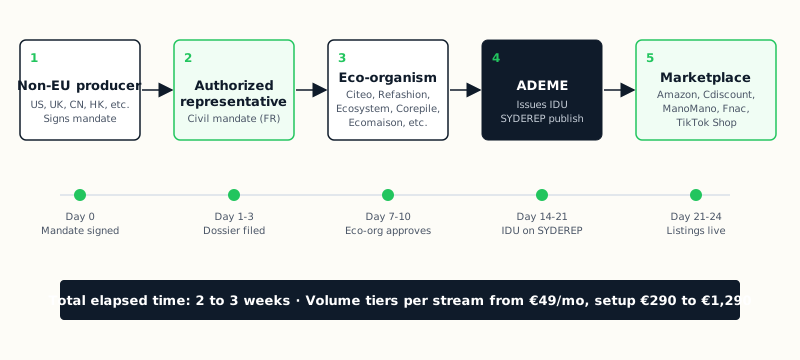
Where the producer is not established in France, it must appoint a France-established authorised representative under the written mandate of Article L. 541-10-9-1. The mandate is signed electronically, with no notarisation. See our article on whether you actually need a French entity vs a representative, the cost arithmetic strongly favours the representative for non-EU producers without other commercial reasons to incorporate.
What does the authorised representative answer for?
You remain the producer. Under the written mandate required by Article L. 541-10-9-1 of the French Environmental Code, we take charge of and answer for your registration, your identifier, your declarations, the exchanges with the eco-organisation and audits, and the archiving of your files. Your eco-contributions stay invoiced to you and paid by you directly to the eco-organisation. Our mandataire REP article walks through what a representative does, what it cannot do, and how to choose one.
Since 10 July 2026 the appointment is compulsory rather than optional, and the obligation is broader than it looks: it reaches online intermediation platforms not established in France, and it catches producers who had joined an eco-organism directly before that date, who must now appoint a representative and have the mandate registered with each eco-organism. Our analysis of law n° 2026-602 and Article L. 541-10-9-1 covers the scope, the three conditions of the mandate and the regularisation path.
How is French EPR enforced?
Two enforcement channels operate in parallel: marketplace verification (Amazon France, Cdiscount, ManoMano, Fnac, TikTok Shop, all querying SYDEREP) and administrative sanctions (ADEME/DGCCRF under L. 541-9-5, after a formal notice from the administration). Our penalties article covers each channel with concrete exposure numbers. For the operational response when a letter or notice arrives, see how to respond to an ADEME letter and how to recover from an Amazon France suspension.
Common pitfalls
Four mistakes account for most enforcement issues we see. Each is a direct consequence of misreading one of the legal layers above.
Frequently asked questions
Does the French AGEC law actually apply to my US LLC?
Yes. Article L. 541-10 II of the Code de l’environnement, introduced by AGEC, defines the producer as whoever places a product in scope of a French EPR stream on the French market for the first time, regardless of where that entity is established. A US LLC shipping cross-border to French consumers is a French EPR producer and must register through a France-established representative.
What is the legal difference between a French EPR representative and a French distributor?
They are legally distinct. The distributor takes title to the goods in France and is the producer themselves. The authorised representative does not take title: it acts under the written mandate required since 10 July 2026 by Article L. 541-10-9-1 of the Code de l’environnement, and you remain the producer. Choosing one or the other changes who is on the SYDEREP register and whom the eco-organisms treat as the producer.
Did the EcoDDS ruling change the representative regime in practice?
Today the EcoDDS ruling concerns producers established in France. The Conseil d’État’s 10 November 2023 decision (case 449213) annulled the regulatory clause that transferred obligations between operators, holding that this belongs to statute, not to a decree. For producers not established in France, the legal basis is now a written mandate under Article L. 541-10-9-1 of the Code de l’environnement, created by law n° 2026-602 of 8 July 2026: since 10 July 2026, any producer not established in France and subject to EPR must appoint a representative established in France, for every stream. You remain the producer. Under that written mandate required by Article L. 541-10-9-1 of the French Environmental Code, the representative takes charge of and answer for your registration, your identifier, your declarations, the exchanges with the eco-organisation and audits, and the archiving of your files. Your eco-contributions stay invoiced to you and paid by you directly to the eco-organisation. Mandate templates written before 10 July 2026 should be reviewed.
What is the maximum fine I can face under French EPR law?
Article L. 541-9-5 of the Code de l’environnement sets the sanctions: up to €30,000 (failure to register on SYDEREP, missing IDU display, or erroneous declared data, a ceiling, not a per-SKU multiplier) plus up to €7,500 per unit or per tonne of non-compliant product placed on the French market for a legal entity (€1,500 per unit or per tonne for an individual). A sanction comes only after a formal notice from the administration. A missing Info-tri marking is fined separately under Article L. 541-9-4: up to €3,000 (individual) or €15,000 (company) per reference. Marketplaces are required to deactivate listings without a valid IDU. Compliance costs a fixed annual fee per stream, stated in a written quote within one business day, plus the eco-contributions: a fraction of that exposure.
Did PPWR replace AGEC on 12 August 2026?
No. PPWR is an EU regulation focused on packaging that sits on top of national EPR schemes. AGEC continues to govern the 19 French EPR streams. Since 12 August 2026, Article 45 of Regulation (EU) 2025/40 requires a producer that makes packaging available in a member state where it is not established, including from another EU country, to appoint an authorised representative for extended producer responsibility in that member state.
Does an Italian or German company need a French representative to ship to France?
Yes, when the producer is not established in France. EU establishment elsewhere does not exempt; what matters is establishment in France specifically for French EPR purposes. An Italian SRL or German GmbH that places packaging on the French market without a French establishment designates a France-established representative.
All articles in this legal cluster
When you are ready to act on the legal framework: our mandate covers the full representative role, at a fixed annual fee per stream from €190/year excl. VAT (how our pricing works). Send your case to our contact form for a written quote within one business day.
Sources & references
Every legal claim in this pillar traces to one of the primary sources below, Légifrance, EUR-Lex, Conseil d’État ArianeWeb, ADEME, plus specialist legal analysis. Verified 24 May 2026.
- Article L. 541-10 du Code de l’environnement, Légifrance · Producer definition and authorised representative regime.
- Article L. 541-10-9 du Code de l’environnement, Légifrance · Joint liability of online marketplaces.
- Article L. 541-9-5 du Code de l’environnement, Légifrance · Substantive administrative sanctions.
- Article L. 541-9-4 du Code de l’environnement (sanction de l’Info-tri), Légifrance · Procedure: notification, observations, mise en demeure.
- Loi n° 2020-105 du 10 février 2020 (AGEC), Légifrance
- Conseil d’État, 10 novembre 2023, n° 449213 (EcoDDS), Actu-Environnement · Annulled Article R. 541-174 (transfer of obligations to the mandataire), full headnote.
- Regulation (EU) 2025/40 (PPWR), EUR-Lex · Adopted 19 December 2024, OJEU 22 January 2025, applicable since 12 August 2026.
- Directive 2008/98/EC (Waste Framework Directive, consolidated), EUR-Lex
- Cadre général des filières REP, Ministère de la Transition écologique
- SYDEREP, registre public des producteurs (ADEME)
Get your fixed quote in one business day
The entry price is public: from €190/year excl. VAT per EPR stream. Tell us your streams, volumes and product references, and you receive a fixed written quote within one business day, before any commitment. Eco-contributions are set by the eco-organisms on their published schedules and stay separate from our fee: we take no percentage on them.