

Update, 28 July 2026: the start is now set for 1 January 2027. By official ministry press release of 28 July 2026, the EPRO eco-contribution start, postponed sine die on 26 June 2026, is fixed for 1 January 2027. The ministry asks the eco-organisms to publish their 2027 barèmes from September 2026. Background (30 June 2026 update): on 26 June 2026, France's Minister for Ecological Transition, Mathieu Lefèvre, had announced the sine die postponement of the stream, which was due to start on 1 July 2026. The reasons given: not all contributors had been identified (late publication of the European Commission guidelines in June 2026) and the eco-organisms' barèmes had only just been made public. The legal framework, the three accredited eco-organisms and their published barèmes all remain valid, only the start date of eco-contributions changes. This guide stays accurate; the dates below reflect the 1 January 2027 start.
For months, the question came up in every conversation with a foreign producer: "Fine, the new professional packaging EPR exists, but what does it actually cost?" Until early June 2026, the honest answer was: the framework is set, the barème is not. That is no longer true. The eco-contribution barèmes for France's professional packaging EPR are now published, and the start, scheduled for 1 July 2026, but postponed sine die on 26 June 2026, then set for 1 January 2027 by ministerial announcement (late July 2026), is finally something you can put a number on.
Key takeaways
- The three eco-organisms, Citeo Pro, Léko Pro and Twiice, were accredited in early June 2026, following their 7 May 2026 hearing before the inter-stream REP commission. Accreditation is exactly what unlocks publication of the barèmes by packaging category and material.
- The barèmes apply from the stream's start, 1 July 2026 (postponed sine die on 26 June 2026; start now set for 1 January 2027), with no retroactivity for the period before the start.
- Architecture: material-by-material financing, modulated by bonuses/penalties (reduction, reusability, recyclability, recycled content).
- Reused packaging pays no eco-contribution, the scheme's strongest incentive.
- A producer not established in France must appoint an authorized representative (mandataire) to register, declare and pay, reinforced by PPWR Article 45 from 12 August 2026.
- Lecteur francophone ? Lisez la version française de ce guide.
We act as your France-established authorized representative: eco-organism membership, IDU, barème calculation and the annual declaration under one mandate. See /pricing or contact us for a written quote in one business day. For the full stream overview, start with our professional packaging EPR 2026 guide.
What just happened: accreditation unlocks the barèmes#
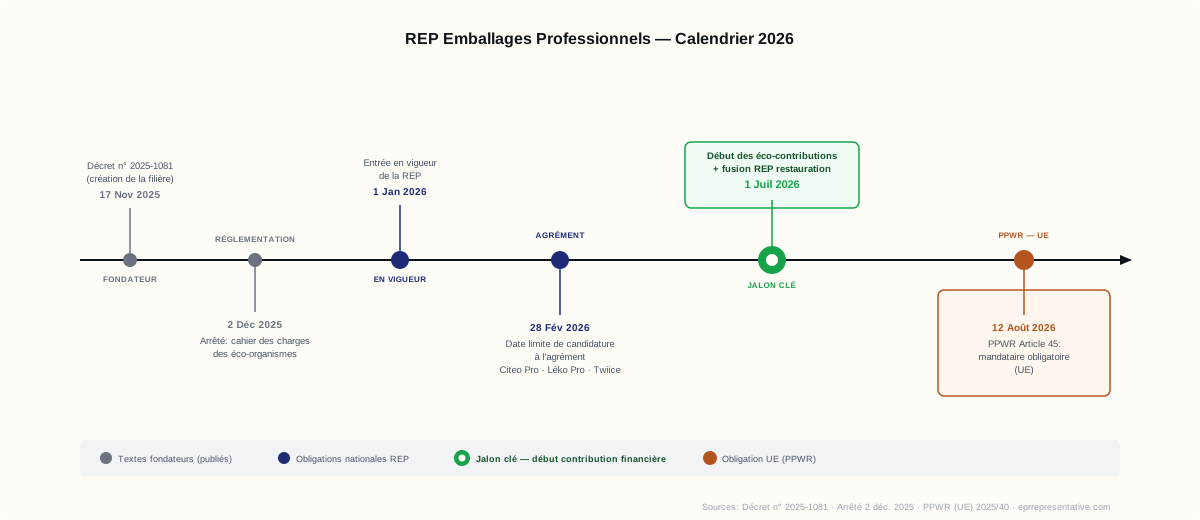
The regulatory sequence is now complete. Décret n° 2025-1081 of 17 November 2025 created the stream; the arrêté of 2 December 2025 set the cahier des charges (terms of reference); the accreditation application deadline was 28 February 2026. Three eco-organisms applied, Citeo Pro, Léko Pro and Twiice, and after their 7 May 2026 hearing before the inter-stream REP commission, they were accredited in early June 2026, one month before launch.
Accreditation is not a calendar formality: it is the legal act that authorises each eco-organism to publish its eco-contribution barème by packaging category and material. Until accredited, an eco-organism cannot contract or invoice. Since early June 2026, all three can therefore display their grids, and producers can finally cost their contribution ahead of the first payment, scheduled for 1 July 2026, but postponed sine die on 26 June 2026, then set for 1 January 2027 by ministerial announcement (late July 2026).
"The barème is the moment EPR stops being a principle and becomes a budget line. My non-EU clients do not ask whether the stream exists, they ask what it costs on the real catalogue. Now that the grids are published, we can answer per kilo and per tonne, and, more importantly, show how eco-modulation and reuse pull the bill down." , Leo Escourrou, founder, EPR Representative (France-established mandataire REP), Paris
How to read the barème: material-by-material financing#
The structuring principle of the cahier des charges is simple to state and consequential: each material finances its own chain. Cardboard pays for cardboard's end-of-life, plastic for plastic's, wood for wood, and so on. There is no hidden cross-subsidy from one material to another.
In practice, your professional packaging eco-contribution is built in three steps:
- Tonnage by material. For each material (cardboard, paper, plastic, wood, metal, glass, textile), you declare the quantity of packaging placed on the French market. Unlike household packaging, often counted per consumer sales unit (UVC), professional packaging is declared mainly per tonne.
- The base rate per material. The eco-organism applies the per-material unit rate from its published barème (often per plastic sub-category too: PET, PE-HD, PP, PS, etc.).
- Eco-modulation. Bonuses reduce the contribution; penalties raise it, based on the packaging's environmental characteristics (next section).
Material × tonnage × eco-modulation is what sets your annual eco-contribution.
The published rates, material by material#
All three accredited eco-organisms have published their grid in euros per tonne. Here are the official figures from the published tariff documents (amounts excl. VAT).
Léko Pro, schedule for the 2nd half of 2026 (« Barème des emballages professionnels applicable au 1er juillet 2026 »):
| Material | Léko Pro rate (€/t) |
|---|---|
| Plastics | 217.7970 |
| Cardboard | 34.7221 |
| Wood | 8.0786 |
| Other materials (glass, aluminium, steel, textile, ceramics, cork…) | 5.0590 |
| Non-plastic materials of dangerous-product packaging | 82.6965 |
Flat fee of €95 excl. VAT per semester for placings under 2 tonnes (simplified declaration on MyLéko from January 2027); €95 is also the minimum semester invoice. Majority-material rule: a material under 5% of the packaging unit's weight may be declared under the predominant material, except plastic (Article 9 of the order of 22 April 2026).
Twiice, schedule updated July 2026 (applicable from the stream's entry into force):
| Material | Single-use (€/t) | Reusable (−50%) | Reused |
|---|---|---|---|
| Plastic (all resins) | 217.56 | 108.78 | €0 |
| Paper-cardboard | 34.67 | 17.34 | €0 |
| Wood | 8.98 | 4.49 | €0 |
| Steel | 23.63 | 11.82 | €0 |
| Aluminium | 5.39 | 2.70 | €0 |
| Glass | 5.39 | 2.70 | €0 |
| Other materials | 38.00 | 19.00 | €0 |
Twiice flat fee: €100 excl. VAT per year under 2 tonnes. Special case for IBCs, declared per unit: €2 per new IBC (€1 if reusable, €0 reused), €1 per new liner of a reconditioned IBC (€0.50 reusable). A recycled-plastic incorporation bonus arrives from 2027.
Citeo Pro's EPRO schedule (« Guide du tarif EPRO 2026 », placings 1 July-31 December 2026): plastic €217.90/t, paper-cardboard €34.70/t, wood €9/t, steel, aluminium and other materials €8/t, non-plastic dangerous-product packaging €82.80/t, with a €125 excl. VAT flat fee under 2 tonnes and a -50% reuse bonus. Separately, as long as the professional packaging stream is not in force, the food-service packaging REP (ER) also remains applicable at Citeo Pro for 2026 restauration placings: flat fee of €80 excl. VAT up to 1,000 primary packaging units per year, then a per-material weight contribution (from €17/t for glass to €336.10/t for PVC, paper-cardboard €75.80/t, common rigid/flexible plastics €123.20 to €134.40/t), declaration between January and February 2027.
Quick read of the Léko Pro vs Twiice gaps: near-parity on the two heavy B2B lines (plastics ≈ €217.6–217.8/t, cardboard ≈ €34.7/t), but clear gaps elsewhere: steel is 4.7× cheaper at Léko Pro (€5.06/t under "other materials" vs €23.63/t), "other materials" 7.5× cheaper (€5.06 vs €38/t), while wood is slightly cheaper at Léko Pro (€8.08 vs €8.98/t) and Léko Pro applies a specific dangerous-products surcharge (€82.70/t on non-plastic materials) that the Twiice grid does not have. Your mix decides: run your tonnage through our EPRO rates comparator to see both totals in euros.
The lesson is clear and actionable: a mono-material, recyclable, lightweighted item pays little; a technical multilayer non-recyclable plastic pays a lot, before penalties even apply. Plastic is explicitly the stream's priority, a 55% recycling target by 2030, roughly +300,000 tonnes captured per year, and over €300M directed to non-hazardous plastics collection and sorting at an attractive support rate. A traceability support of €5/t for plastic (€2/t for other materials) rounds out the scheme.
Need a French EPR representative for your business?
We are EPR France specialists for foreign sellers. Fixed annual fee per stream, from €190/year excl. VAT, confirmed in a written quote within one business day, IDU in 2 to 3 weeks.
Eco-modulation: what moves your eco-contribution#
The base rate is only a starting point. Eco-modulation, the bonus/penalty system, can move the final amount substantially. The cahier des charges makes it a central lever on four axes:
- Source reduction. Less material per item (no over-packaging, lighter films, optimised dunnage): less declared tonnage, hence a mechanically lower contribution, plus a possible bonus.
- Reusability / reuse. Packaging designed for reuse and managed in an operational system exits the charged barème (next section), the most powerful incentive.
- Recyclability. Packaging designed to be recycled (mono-material, no sorting disruptors) is rewarded; non-recyclable packaging (multilayer, inseparable cardboard/plastic, hazardous substances) is penalised.
- Recycled content (plastics). Incorporating recycled plastic (PCR) lowers the contribution on the relevant share.
For the general mechanics of REP bonuses/penalties, which carry across streams, see our eco-modulation guide. In practice, two companies at the same tonnage can pay very different amounts depending on packaging design.
The reuse premium: reused packaging pays nothing#
This is the most structuring novelty of the 2026 barème, and the one that changes the underlying maths. Reused professional packaging, when managed within an operational reuse system, is reported through a dedicated reuse reporting, but is not subject to the eco-contribution.
In other words, switching a single-use plastic crate, a pallet or an IBC into a reuse loop does not merely reduce your contribution: it removes it on the units concerned (while they remain declared). The cahier des charges reinforces this:
- eco-organisms must devote at least 5% of eco-contributions to reuse solutions;
- the stream targets 40% of transport packaging reused by 2030, then 70% by 2040;
- financial reuse-incentive mechanisms come into place from the stream's start, scheduled for 1 July 2026, but postponed sine die on 26 June 2026, then set for 1 January 2027 by ministerial announcement (late July 2026).
For a producer shipping at volume on transport packaging (pallets, big bags, shuttle crates, IBCs), this is the most profitable optimisation in the barème. Twiice, the eco-organism 100% dedicated to professional packaging, is positioned precisely on the plastics-and-reuse question.
Declaration timeline: the first year is special#
A barème is useless without the declaration calendar. With the start fixed for 1 January 2027 (initially 1 July 2026, postponed sine die on 26 June 2026), the launch rhythm differs from steady state:
| Date | What happens |
|---|---|
| During 2026 | Adhesion window: join Citeo Pro, Léko Pro or Twiice, file the provisional declaration of your placements, obtain the IDU. No eco-contribution is charged on 2026 volumes (no retroactivity). |
| 1 January 2027 | Eco-contributions begin (start fixed by official ministry press release, late July 2026). Food-service stream merged in. |
| Early 2028, then annually | Steady state: annual declaration of the prior year's (N-1) quantities, starting with 2027 volumes, settled against the provisional declaration. |
From 2028, the stream aligns with the classic French EPR rhythm: one annual declaration of the previous year's quantities, the eco-organism applying the barème in force. A producer not established in France hands the whole sequence, membership, barème calculation and declaration, to its authorized representative.
Three barèmes, one architecture: Citeo Pro vs Léko Pro vs Twiice#
The three accredited eco-organisms apply the same regulatory architecture (material-based financing + eco-modulation + reuse not charged) but each publishes its own grid and terms. How to arbitrate between barèmes:
| Eco-organism | Profile | What its published schedule says |
|---|---|---|
| Citeo Pro | B2B arm of Citeo (household and food-service packaging) | Plastic €217.90/t, cardboard €34.70/t, wood €9/t, steel/aluminium/other materials €8/t; dangerous-products surcharge €82.80/t (non-plastic); €125 flat fee/year < 2 t; -50% reuse bonus |
| Léko Pro | B2B offering of challenger Léko | Plastics €217.80/t, cardboard €34.72/t, wood €8.08/t, other materials €5.06/t; dangerous-products surcharge €82.70/t (non-plastic); €95 flat fee/semester < 2 t |
| Twiice | 100% professional-packaging specialist | Plastic €217.56/t, paper-cardboard €34.67/t, wood €8.98/t, steel €23.63/t, alu/glass €5.39/t, other €38/t; per-unit IBCs; €100 flat fee/year < 2 t |
The right comparison criteria are not the base rates alone, but: (1) the rate on your dominant materials, price it in 30 seconds with the EPRO rates comparator; (2) the granularity of the bonuses for reuse / recyclability / recycled content you can actually capture; (3) the ability to bundle your other streams (household, WEEE, batteries) for simpler management. See also our household-side comparison, Citeo vs Léko vs Adelphe.
We are eco-organism-neutral: we compare the published barèmes for your real catalogue and register you with whichever minimises your total cost.
What compliance costs, barème included#
To budget, add three layers:
1. The eco-contribution (at barème). Paid to your eco-organism, per tonne by material, after eco-modulation. This is the variable layer, a function of your tonnage and packaging design.
2. Eco-organism membership. From around €80 HT per year (first-year minimum), with the variable share scaling to declared tonnage.
3. The authorized-representative fee (if you are not established in France). Our fee is a fixed annual amount per EPR stream, from €190/year excl. VAT for streams under the eco-organism flat-fee regime, confirmed in a written quote within one business day. The fee follows the stream's declarative regime and the number of product references, never sales volume. A one-time setup per stream and a refundable security deposit are stated in the quote. No markup on the eco-contribution, no per-SKU surcharge.
Indicative example. A non-French manufacturer ships palletised goods to French distributors: cardboard boxes (corrugated), stretch film (plastic) and wooden pallets. It budgets our fixed annual representative fee (written quote), about €80/year membership, plus the eco-contribution at barème on the declared tonnage. If it shifts pallets and shuttle crates to reuse, the "transport" share exits the charged barème. Estimate your eco-contributions in the eco-contribution simulator, or send us your packaging mix for a quote costed against the published barème.
The cost of compliance vs the cost of doing nothing#
| Amount | |
|---|---|
| Representative fee (this stream) | Fixed annual amount, confirmed in a written quote |
| Eco-organism membership (first-year minimum) | from about €80/year |
| Administrative fine, no IDU (L. 541-9-5) | up to €30,000 |
| Penalty per unit or tonne placed non-compliant (L. 541-9-5) | up to €7,500 |
French EPR sanctions (Articles L. 541-9-5 and L. 541-9-6 of the Code de l'environnement) are among the heaviest in the EU, and distributors and B2B marketplaces increasingly require a valid IDU. See EPR penalties in France.
What a foreign producer should do now#
The window before the stream's start, scheduled for 1 July 2026, but postponed sine die on 26 June 2026, then set for 1 January 2027 by ministerial announcement (late July 2026), is short, and the extra time is best used to prepare. A practical sequence:
- Map your packaging by material, this is the barème's input. List cardboard, plastics (by resin), wood, metal, glass and the associated tonnages.
- Spot your optimisation pockets, mono-material vs multilayer, lightweighting, and especially transport packaging you can switch to reuse (exits the charged barème).
- Compare the barèmes of Citeo Pro / Léko Pro / Twiice on your dominant materials, or have your representative do it.
- Appoint a French authorized representative if you are not established in France, required for this stream and by PPWR Article 45. Our authorized representative page explains the role.
- Join, get your IDU, declare and pay from the stream's start, scheduled for 1 July 2026, but postponed sine die on 26 June 2026, then set for 1 January 2027 by ministerial announcement (late July 2026).
We compute your barème and register the stream for you#
We act as your France-established authorized representative for the professional packaging EPR: comparison of the published barèmes (Citeo Pro, Léko Pro, Twiice) for your real catalogue, optimisation through eco-modulation and reuse, membership, IDU on the public ADEME register, and the annual SYDEREP declaration, under one mandate that can also cover your household packaging, WEEE, batteries and other streams. Our fee is a fixed annual amount per EPR stream, from €190/year excl. VAT for streams under the eco-organism flat-fee regime, confirmed in a written quote within one business day. See /pricing, send your packaging mix to /contact for a quote within one business day, or book a call with founder Leo Escourrou.
Frequently asked questions#
Are the professional packaging EPR barèmes published?#
Yes. Citeo Pro, Léko Pro and Twiice were accredited in early June 2026, following their 7 May 2026 hearing before the inter-stream REP commission. Accreditation authorises publication of the barèmes by packaging category and material, applicable from the stream's start, scheduled for 1 July 2026, but postponed sine die on 26 June 2026, then set for 1 January 2027 by ministerial announcement (late July 2026). Always check the version in force on your eco-organism's website.
How is the eco-contribution calculated?#
Material by material, mainly per tonne, under "each material finances its own chain," then modulated by bonuses/penalties (reduction, reusability, recyclability, recycled content). You declare quantities and materials; the eco-organism applies barème and modulation.
Do reused packaging items pay?#
No. Reused packaging managed in an operational reuse system is declared (reuse reporting) but not charged the eco-contribution. Eco-organisms must devote at least 5% of contributions to reuse; targets of 40% of transport packaging reused by 2030 and 70% by 2040.
Which materials cost the most?#
Technical plastics that are hard to recycle (PS, PP, multilayer) lead, then aluminium and PET/PE-HD; corrugated cardboard, steel and glass are markedly cheaper. Plastic is the stream's priority (55% recycling targeted by 2030).
When do I declare and pay?#
Eco-contributions start on 1 January 2027 (no retroactivity: 2026 volumes are never charged). Provisional declaration at adhesion, then the first declaration of actual volumes in early 2028 covering 2027 quantities; annual N-1 declarations thereafter.
What does compliance cost?#
The eco-contribution at barème + membership (from ~€80 HT/year) + the representative fee if you are not established in France: a fixed annual amount per stream, confirmed in a written quote, with a one-time setup and a refundable security deposit stated in the quote. No markup on the eco-contribution.
Citeo Pro, Léko Pro or Twiice?#
Same architecture, three different grids. Compare on your dominant materials, the granularity of the reuse/recyclability/recycled-content bonuses, and the ability to bundle your other streams. We are neutral and pick the cheapest barème for your catalogue.
Is the professional barème the same as the household one?#
No, separate streams, IDUs, barèmes and declarations. Household covers packaging reaching a consumer (often by UVC and weight); professional covers packaging reaching a business (mainly per tonne).
Sources & references#
All regulatory claims trace back to the following primary and authoritative sources (Légifrance, the Ministère de la Transition écologique, ADEME, the accredited eco-organisms and the trade press). Verified June 2026.
- Décret n° 2025-1081 du 17 novembre 2025 instituant la filière REP des emballages professionnels, Légifrance
- Arrêté du 2 décembre 2025 portant cahier des charges de la filière REP des emballages professionnels, Légifrance
- REP: Citeo Pro, Léko Pro and Twiice accredited for professional packaging (June 2026), L'Usine Nouvelle
- Candidate eco-organisms for professional packaging REP obtain accreditation, Process Alimentaire
- Professional packaging EPR start postponed (26 June 2026), actu-environnement
- The launch of the professional packaging EPR stream is postponed again, Banque des Territoires
- Professional packaging REP stream (EPRO / EIC), ADEME
- Professional Packaging FAQ, Citeo Pro
- Twiice, eco-organism 100% professional packaging
- Unique identifier (IDU) for REP streams, ADEME
- Professional packaging, Ministère de la Transition écologique
Ready to start your French EPR registration?
Three-minute application wizard. Written quote within one business day. Eco-organism membership within 48 to 72 hours. IDU in 2 to 3 weeks.