

Update, 28 July 2026: the start is now set for 1 January 2027. By official ministry press release of 28 July 2026, the EPRO eco-contribution start, postponed sine die on 26 June 2026, is fixed for 1 January 2027. The ministry asks the eco-organisms to publish their 2027 barèmes from September 2026. Background (30 June 2026 update): on 26 June 2026, France's Minister for Ecological Transition, Mathieu Lefèvre, had announced the sine die postponement of the stream, which was due to start on 1 July 2026. The reasons given: not all contributors had been identified (late publication of the European Commission guidelines in June 2026) and the eco-organisms' barèmes had only just been made public. The legal framework and the three accredited eco-organisms (Citeo Pro, Léko Pro, Twiice) all remain in place, only the start date of eco-contributions changes. This guide stays accurate; the dates below reflect the 1 January 2027 start.
France has created a new Extended Producer Responsibility (EPR) stream for professional packaging, the boxes, pallets, drums and films that move goods between businesses rather than to consumers. After years of consultation it is now law, and the start of eco-contributions, originally scheduled for 1 July 2026, but postponed sine die on 26 June 2026, then set for 1 January 2027 by ministerial announcement (late July 2026), is the next milestone.
Key takeaways
- The REP emballages professionnels (professional/commercial packaging EPR, also called EPRO or EIC, emballages industriels et commerciaux) is created by décret n° 2025-1081 of 17 November 2025 and the arrêté of 2 December 2025.
- It is in force from 1 January 2026; producers were due to start paying eco-contributions on 1 July 2026, but this was postponed sine die on 26 June 2026, then set for 1 January 2027 by ministerial announcement (late July 2026), with no retroactive effect.
- At the start date, now 1 January 2027, it absorbs the former food-service (restauration) packaging stream.
- Three eco-organisms are accredited since early June 2026: Citeo Pro, Léko Pro and Twiice.
- A producer not established in France must appoint a French authorized representative (mandataire), the same duty reinforced by PPWR Article 45 from 12 August 2026.
- Lecteur francophone ? Lisez la version française de ce guide.
We act as your France-established authorized representative for the professional packaging stream, eco-organism dossier, IDU and annual declaration under one mandate. See /pricing or contact us for a written quote in one business day.
What changed: the 2026 professional packaging REP, in brief#
For three decades, French packaging EPR meant household packaging, the boxes and bottles that reach consumers, managed by Citeo, Léko and Adelphe. Packaging that circulated purely between professionals had no dedicated EPR scheme. The 2020 AGEC law (loi n° 2020-105) mandated closing that gap, and the implementing texts have now landed:
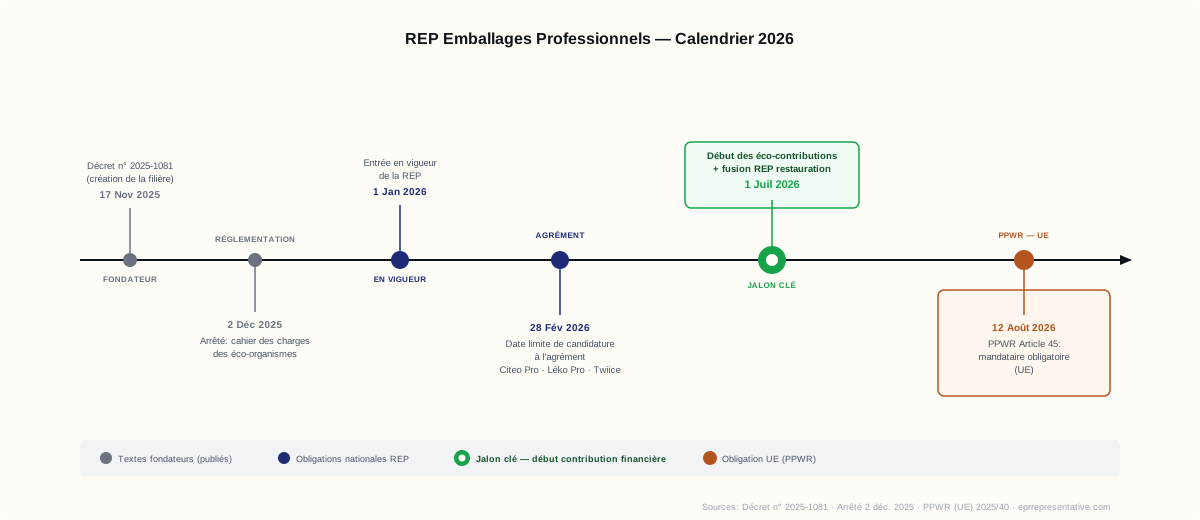
- Décret n° 2025-1081 (17 November 2025), formally creates the REP filière for emballages servant à commercialiser des produits consommés ou utilisés par des professionnels (packaging used to market products consumed or used by professionals).
- Arrêté of 2 December 2025, the definitive cahier des charges (terms of reference) for accredited eco-organisms, individual systems and coordinating bodies.
- 1 January 2026, regulatory entry into force.
- 1 July 2026, eco-contribution payments were scheduled to begin (and the existing food-service (restauration) packaging stream to be folded into the broader professional packaging REP), but this start was postponed sine die on 26 June 2026, then set for 1 January 2027 by ministerial announcement (late July 2026).
The headline shift in the definitive cahier des charges: reuse (réemploi) becomes a structuring pillar, alongside a material-by-material financing principle and a strong push on professional plastic recycling.
"The trap for 2026 is assuming B2B packaging is exempt. It is not, and once eco-contributions begin, scheduled for 1 July 2026, but postponed sine die on 26 June 2026, then set for 1 January 2027 by ministerial announcement (late July 2026), a producer not established in France needs a French authorized representative to register, declare and pay, just as PPWR Article 45 will require. The companies that map their packaging now will be compliant before their first declaration; the ones that wait will be doing it under a distributor's ultimatum." , Leo Escourrou, founder, EPR Representative (France-established mandataire REP), Paris
Professional, household or food-service? Where your packaging falls#
France now runs three packaging EPR perimeters. Getting the boundary right is the difference between a valid registration and a rejected one.
| Perimeter | What it covers | Eco-organisms |
|---|---|---|
| Household packaging | Packaging that reaches a French consumer | Citeo, Léko, Adelphe |
| Professional packaging (new) | Packaging that reaches a French business, professional or institution | Citeo Pro, Léko Pro, Twiice |
| Food-service (restauration) | Large-format catering packaging, merged into professional packaging on 1 July 2026 (postponed sine die on 26 June 2026; start now set for 1 January 2027) | formerly Citeo Pro |
The decisive test is the recipient: a consumer means household packaging; a professional means the new professional packaging REP. A producer with both B2C and B2B channels needs both registrations. We break that split down in our Citeo Pro / EPRO guide.
Need a French EPR representative for your business?
We are EPR France specialists for foreign sellers. Fixed annual fee per stream, from €190/year excl. VAT, confirmed in a written quote within one business day, IDU in 2 to 3 weeks.
Which products and packaging are in scope#
This is the part that matters for classifying your catalogue. The REP applies to the three classic packaging layers when they accompany goods sold to, or used by, professionals.
1. Sales (primary) packaging, in direct contact with the product:
- Drums and barrels (fûts)
- Jerricans and cans (bidons)
- Crates and trays (cagettes)
- Tubs, pots and buckets (pots, seaux)
- Bottles, flasks and canisters used in B2B supply
- Bags and sacks (sacs)
2. Grouping (secondary) packaging, used to bundle units together:
- Cardboard cases and boxes (caisses, boîtes en carton)
- Trays and shrink-wrapped bundles
- Totes and returnable containers
3. Transport (tertiary) packaging, used to move goods through the supply chain:
- Pallets (palettes), wood, plastic or cardboard
- Stretch films and shrink films (films)
- Strapping, corner protectors and dunnage (calages, cornières)
- Big bags
4. Specific items named in the texts:
- Intermediate bulk containers / IBCs (grands récipients vrac, GRV)
- Drums over 29 litres (fûts de plus de 29 litres)
Materials covered: cardboard, paper, plastic, wood, metal (steel, aluminium), glass and textiles/fabric.
Sectors concerned, essentially all of B2B#
The scope is deliberately broad. Among the sectors explicitly identified by the regulator and the eco-organisms: agri-food, automotive, pharmaceuticals and health, DPH (droguerie / perfumery / hygiene), furniture, textiles, large-scale distribution, aeronautics, logistics, and food-service (CHR / HORECA, large formats). In practice, if your business ships products to French companies in any packaging, assume you are in scope until you have confirmed otherwise.
What is excluded#
Four categories stay outside the new REP because they are already covered by other schemes or specific rules:
- Packaging of mineral and synthetic oils.
- Packaging of hazardous chemical products (significant health or environmental risk).
- Packaging of construction products, covered by the PMCB construction REP (see Valobat vs Ecominéro).
- Packaging of agricultural supplies (agrofourniture).
Who has to register#
You are a "producer" for this REP if you are a professional who packages, or has products packaged, to place them on the French market, or any importer of a packaged product placed on the French market. That captures manufacturers, brand owners, importers, wholesalers, distributors and B2B e-commerce sellers. Our pro-packaging service page lists who typically falls in.
Foreign producers: an authorized representative is mandatory. If your company is not established in France, you must designate a French authorized representative (mandataire) to register, declare and pay on your behalf. This mirrors the household-packaging rule and converges with the EU-wide PPWR Article 45 obligation that also applies from 12 August 2026, so a non-French company selling B2B into France now faces the representative requirement from two directions at once. (See our PPWR Article 45 guide and why foreign sellers need a mandataire.)
One useful nuance from the cahier des charges: registered producers have a "double status", they are both obligated (they pay the eco-contribution) and beneficiaries (the collection of their own professional packaging waste is supported by the scheme).
Citeo Pro vs Léko Pro vs Twiice: which eco-organism?#
Three eco-organisms declared their candidacy by the 28 February 2026 deadline; the three eco-organisms were accredited in early June 2026. You register with one of them, or run an approved individual system.
| Eco-organism | Background | Orientation |
|---|---|---|
| Citeo Pro | B2B arm of Citeo, France's historic household-packaging eco-organism; already runs the food-service packaging stream | Broad, multi-material; partnered with Ecomaison for adjacent flows |
| Léko Pro | B2B offering of Léko, the challenger household-packaging eco-organism | Multi-material; positioned on competitive rates |
| Twiice | A specialist 100% dedicated to professional packaging | Plastics and the reuse-vs-single-use question; partnered with Valobat |
How to choose, in practice:
- Material mix, if your packaging is plastic-heavy or reuse-oriented, weigh Twiice; for broad multi-material B2B, Citeo Pro and Léko Pro are natural fits.
- Rates and eco-modulation, every barème integrates bonuses and penalties for waste reduction, reusability, recyclability and (for plastics) recycled content. Compare the published barèmes once accreditations land; see how the bonus/malus logic works in our eco-modulation guide.
- Bundling, if you also register household packaging, WEEE or batteries, a single representative keeps all your streams aligned regardless of eco-organism.
We are eco-organism-neutral: we file with whichever fits your catalogue and channel mix. (See also Citeo vs Léko vs Adelphe for the household-side comparison.)
How registration, the IDU and the SYDEREP declaration work#
Every French EPR stream runs on a per-filière identifiant unique (IDU) issued by ADEME through the SYDEREP register. The professional packaging REP is a new, separate filière, so it needs its own IDU, even if you already hold one for household packaging.
The sequence:
- Join an eco-organism (Citeo Pro, Léko Pro or Twiice). In a collective system, the eco-organism registers you in SYDEREP and issues your IDU.
- Receive your IDU, your proof of registration, checkable on the public ADEME register. (See how to verify an IDU and the SYDEREP register guide.)
- Declare annually, the declaration of the previous year's quantities runs roughly January to May. The eco-contribution is calculated on the tonnage and materials you declare; our eco-contribution calculation guide explains the mechanics.
For producers not established in France, your authorized representative performs all three steps on your behalf and holds the relationship with the eco-organism and ADEME.
Key dates and deadlines#
| Date | What happens |
|---|---|
| 10 Feb 2020 | AGEC law sets the legal basis (loi n° 2020-105) |
| 17 Nov 2025 | Framework décret n° 2025-1081 published |
| 2 Dec 2025 | Eco-organism cahier des charges (arrêté) published |
| 1 Jan 2026 | Regulatory entry into force of the professional packaging REP |
| 28 Feb 2026 | Deadline for eco-organisms to apply for accreditation |
| Jan, May (annual) | Declaration window for the prior year's quantities |
| 1 Jul 2026 | Eco-contributions were due to begin and the food-service packaging stream to merge in (postponed sine die on 26 June 2026; start now set for 1 January 2027) |
| 12 Aug 2026 | PPWR Article 45 makes the authorized representative an EU-wide duty for packaging |
The new reuse and recycling targets#
The definitive cahier des charges makes reuse (réemploi) a structuring objective, a first at this scale for a French packaging REP:
- 40% of transport packaging reused by 2030, rising to 70% by 2040.
- Eco-organisms must devote at least 5% of eco-contributions to reuse solutions, with a dedicated reuse technical committee for the filière.
On recycling, the priority is professional plastic, where the 2030 target is 55%, roughly +300,000 tonnes captured per year. Cardboard and wood already sit near 90% and are considered satisfactory; for metals the focus is traceability to isolate the packaging fraction. A traceability support of €5 per tonne for plastic (€2 per tonne for other materials) is paid to collectors. The cahier des charges also sets a structuring principle: each material finances its own management chain.
What it costs#
Two cost layers, as with every French EPR stream, plus our representative fee if you appoint us.
1. Eco-contribution (paid to your eco-organism). Companies pay a per-tonne eco-contribution to Citeo Pro, Léko Pro or Twiice on a barème that finances collection, sorting, recycling and reuse. July 2026 update: the rates are now published in €/tonne. At Léko Pro (2nd half of 2026): plastics €217.80/t, cardboard €34.72/t, wood €8.08/t, other materials €5.06/t, €95 flat fee per semester under 2 tonnes. At Twiice (July 2026 updated schedule): plastic €217.56/t, paper-cardboard €34.67/t, wood €8.98/t, steel €23.63/t, alu/glass €5.39/t, other €38/t, €100 flat fee per year under 2 tonnes. Full grids, gaps and eco-modulation in our professional packaging barème guide, and instant pricing of your mix in the EPRO rates comparator. They rest on the "each material finances its own chain" principle, with bonuses and penalties for reduction, reusability, recyclability and recycled content. The filière is sized at roughly €302 million for the first full year, rising toward €600 million a year by 2030, with plastic carrying the largest share. Eco-organism membership starts low, on the order of €80 HT per year as a first-year minimum, with the variable contribution scaling to your declared packaging tonnage.
2. Our authorized-representative fee (if you appoint us). Our fee is a fixed annual amount per EPR stream, from €190/year excl. VAT for streams under the eco-organism flat-fee regime, confirmed in a written quote within one business day. The fee follows the stream's declarative regime (flat-fee, simplified or itemised) and the number of product references, never sales volume. A one-time setup per stream and a refundable security deposit are stated in the quote. How the fee is built is explained at /pricing; no per-SKU surcharges, no markup on the eco-contribution.
Indicative example. A non-French manufacturer shipping palletised goods (cardboard boxes + stretch film + wooden pallets) to French distributors budgets our fixed annual representative fee (written quote within one business day), about €80/year eco-organism membership, plus the eco-contribution on the declared tonnage of packaging. Estimate the eco-contribution layer in the eco-contribution simulator.
What non-compliance costs#
Skipping the professional packaging REP is not a quiet risk. French EPR sanctions under Articles L. 541-9-5 and L. 541-9-6 of the Code de l'environnement are among the heaviest in the EU:
- Up to €7,500 per unit or per tonne of product placed on the market without meeting the obligation (for a legal entity), and a separate administrative fine of up to €30,000, including for operating without an IDU.
- Commercially, your French distributors and B2B customers increasingly require a valid IDU from suppliers as a purchasing condition, and B2B marketplaces, Cdiscount Pro, ManoMano Pro, Amazon Business, verify it before listing.
The arithmetic is stark:
| Cost | |
|---|---|
| Our representative fee (this stream) | Fixed annual amount, confirmed in a written quote |
| Eco-organism membership (first-year minimum) | from ~€80/year |
| Administrative fine, no IDU (L. 541-9-5) | up to €30,000 |
| Penalty per unit or per tonne placed non-compliant | up to €7,500 |
The representative fee is a small fraction of a single penalty. We lay out the enforcement reality in EPR penalties in France.
What foreign producers should do now#
The window to the eco-contribution start, scheduled for 1 July 2026, but postponed sine die on 26 June 2026, then set for 1 January 2027 by ministerial announcement (late July 2026), is still short, and registration plus eco-organism review takes time. A practical sequence:
- Map your packaging. List every type of professional packaging you place on the French market (sales, grouping, transport) and its material, this drives both the declaration and the eco-contribution.
- Separate B2B from B2C. Packaging that reaches French consumers stays under household Citeo; packaging that reaches French businesses falls under the professional packaging REP. Many producers need both, and B2B-to-retailer flows have their own nuances, see supplying French retailers and wholesalers.
- Appoint a French authorized representative if you are not established in France, required for this stream and for PPWR Article 45.
- Register, obtain your IDU, then declare and pay the eco-contribution from the start date, scheduled for 1 July 2026, but postponed sine die on 26 June 2026, then set for 1 January 2027 by ministerial announcement (late July 2026).
We register the professional packaging stream for you#
We act as your France-established authorized representative for the professional packaging REP: the eco-organism dossier (Citeo Pro, Léko Pro or Twiice), the IDU on the public ADEME register, and the annual SYDEREP declaration, under a single mandate that can also cover your household packaging, WEEE, batteries and other streams. Our fee is a fixed annual amount per EPR stream, from €190/year excl. VAT for streams under the eco-organism flat-fee regime, confirmed in a written quote within one business day. See /pricing or send your packaging and channel mix to /contact for a written quote.
Frequently asked questions#
What is the REP emballages professionnels and when does it start?#
It is France's new EPR scheme for professional (B2B) packaging, the packaging that moves goods between businesses rather than to consumers. Created by décret n° 2025-1081 of 17 November 2025 and the arrêté of 2 December 2025, it is in force from 1 January 2026. Producers were due to start paying eco-contributions on 1 July 2026, but this was postponed sine die on 26 June 2026, then set for 1 January 2027 by ministerial announcement in late July 2026, with no retroactive effect. Any company that places professional packaging on the French market is concerned, and a producer not established in France must appoint a French authorized representative.
Which products and packaging are covered?#
Sales, grouping and transport packaging shipped to professionals: drums (fûts), jerricans (bidons), crates (cagettes), tubs and pots, cardboard cases and boxes, pallets, stretch and shrink films, strapping and dunnage, big bags, IBCs (GRV) and drums over 29 litres, in cardboard, paper, plastic, wood, metal, glass and textile. Packaging of mineral/synthetic oils, hazardous chemicals, construction products and agricultural supplies is excluded.
Does a foreign company need a French authorized representative?#
Yes. A producer not established in France must designate a French authorized representative (mandataire) to register, declare and pay on its behalf, reinforced by PPWR Article 45 from 12 August 2026.
Which eco-organism should I choose, Citeo Pro, Léko Pro or Twiice?#
Three eco-organisms are accredited (arrêtés of 3 June 2026): Citeo Pro (B2B arm of Citeo, already running the food-service stream), Léko Pro (B2B offering of challenger Léko), and Twiice (a specialist 100% dedicated to professional packaging, plastics and reuse focused). Choose on your material mix, the published barème and bonus/penalty grid, and whether you bundle other streams. We are eco-organism-neutral.
How much does it cost?#
Eco-contribution to your eco-organism (material-based barème finalised ahead of the start date, initially scheduled for 1 July 2026, postponed sine die on 26 June 2026, and now set for 1 January 2027; membership around €80 HT/year minimum) plus, if you appoint us, a fixed annual representative fee per stream, confirmed in a written quote within one business day, with a one-time setup and a refundable security deposit stated in the quote.
How do I register and get an IDU?#
Professional packaging is a separate filière, so it needs its own IDU issued by ADEME via the SYDEREP register, even if you already hold one for household packaging. You join an eco-organism (which registers you and issues the IDU), then declare the previous year's quantities annually, roughly January to May. A non-French producer has its representative do this.
What are the penalties for not registering?#
Up to €7,500 per unit or per tonne placed on the market without meeting the obligation (legal entity), plus an administrative fine up to €30,000, including for operating without an IDU (Articles L. 541-9-5 and L. 541-9-6). B2B marketplaces and distributors also verify the IDU.
Is professional packaging EPR different from household Citeo?#
Yes, household packaging covers what reaches consumers (Citeo, Léko, Adelphe); professional packaging covers what reaches French businesses. Separate registrations, separate IDUs, separate declarations.
Do I need both household and professional packaging registration?#
If you sell to both consumers and businesses, yes, one IDU each, declared and paid separately, manageable under a single representative mandate with one written quote covering every stream.
Sources & references#
All regulatory claims in this article trace back to the following primary and authoritative sources (Légifrance, the Ministère de la Transition écologique, ADEME and the accredited eco-organisms). Verified June 2026.
- Décret n° 2025-1081 du 17 novembre 2025 instituant la filière REP des emballages professionnels, Légifrance
- Arrêté du 2 décembre 2025 portant cahier des charges de la filière REP des emballages professionnels, Légifrance
- Loi n° 2020-105 du 10 février 2020 (AGEC), Légifrance
- Emballages professionnels, Ministère de la Transition écologique
- Filière REP des emballages professionnels (EPRO / EIC), ADEME
- Identifiant unique (IDU) des filières REP, ADEME
- REP : trois candidats à l'agrément aux emballages professionnels, L'Usine Nouvelle
- La REP des emballages professionnels, Citeo Pro
- REP emballages professionnels : ce que change le cahier des charges définitif, Environnement Magazine (June 2026)
- Professional packaging EPR start postponed (26 June 2026), actu-environnement
- The launch of the professional packaging EPR stream is postponed again, Banque des Territoires
Ready to start your French EPR registration?
Three-minute application wizard. Written quote within one business day. Eco-organism membership within 48 to 72 hours. IDU in 2 to 3 weeks.